
Importance of the soil test in the region

  • Adapt the system to the site’s conditions
  • Comply with regulations: Q-2, r.22 of the Ministry of the Environment
  • Protect rivers and groundwater.
  • Simplify obtaining municipal permits.
  • Preserve the environment: The test determines whether a conventional leaching field is possible or if an advanced system is required.

Who is Soluo?

Soluo is a multidisciplinary team of 35 septic system experts, operating across all regions of Québec. Since 1995, the team has inspected, designed, and installed more than 500 septic systems every year.
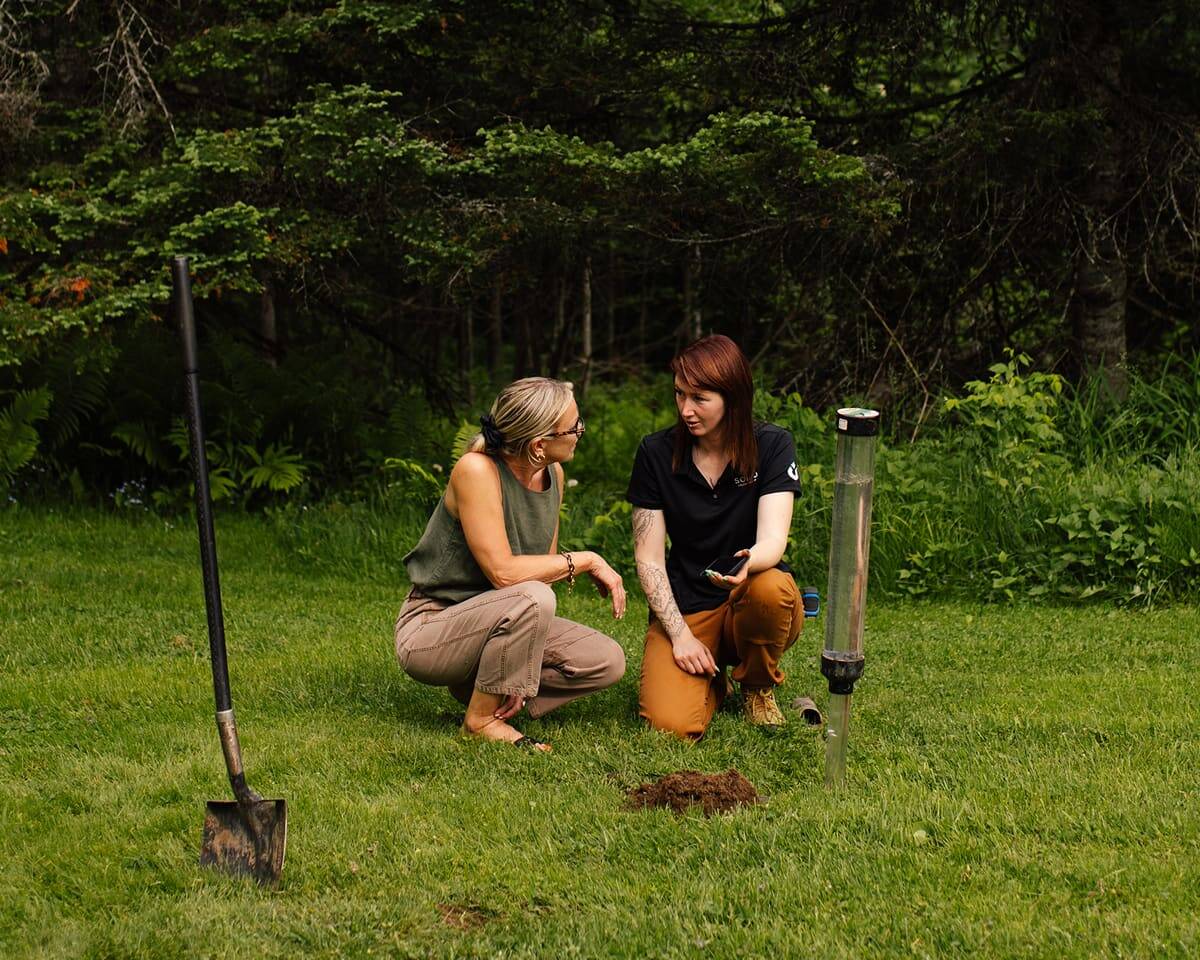

Test de sol pour fosse septique - Soluo

Steps of the Soluo soil test

This first step consists of studying the land to understand its particularities. We evaluate the site’s natural slope, the distances between the house, the well, water bodies and property boundaries, as well as the presence of sensitive zones (e.g., streams, lakes, wetlands).

In the Laurentians, conditions vary enormously: mountain terrains in Sainte-Adèle or Saint-Sauveur, lakeside properties in Saint-Donat or Sainte-Agathe-des-Monts, and agricultural or forested lands in the Saint-Jérôme or Mirabel areas.

This analysis makes it possible to determine the best layout for the future system and to ensure its compliance with municipal and environmental regulations.

The percolation test or soil test measures the rate at which water infiltrates the soil. This is an essential step to determine whether the site can support a conventional system or whether a more specialized system should be considered.

In the Laurentians, soil types vary greatly: a sandy soil in Val-David or Sainte-Agathe will offer rapid infiltration, while a more clayey soil in Saint-Jérôme or Prévost will require an adapted system.

An accurate test guarantees an efficient, long-lasting installation that complies with the requirements of Regulation Q-2, r.22.

This analysis measures the proportion of sand, silt and clay in the soil. These data provide a better understanding of the land’s capacity to filter and absorb water.

For example, the rocky soils of the hills of Morin-Heights or Piedmont behave very differently from the fine, clayey soils of Saint-Colomban or Mirabel.

This step helps avoid unpleasant surprises and ensures that the proposed system will work well over time.

Once the analyses are completed, a complete technical report is produced. It contains all the data collected, the test results and the recommendations for the most appropriate type of septic system.

This report is then submitted to the relevant municipality (e.g., Saint-Sauveur, Sainte-Anne-des-Lacs, Val-Morin, Sainte-Adèle, Saint-Hippolyte), which needs it to issue the installation or replacement permit for the system. The report meets the standards of the Ministry of the Environment and allows the obtaining of the permits.

At the end of the process, personalized recommendations are offered based on the type of soil, the topography and the owner’s needs.

For example, a cottage on Lake Raymond might benefit from a compact tertiary system, whereas a permanent residence in Mirabel might be better served by a conventional system with a leaching field.

This advice helps choose the most sustainable, ecological and economical solution, tailored to the realities of the Laurentians.

Soluo service point icon - Soluo Septic Solutions

Served cities

Our services cover the Laurentians and surrounding areas

We perform your soil tests in the main cities:

  • Mont-Tremblant
  • Saint-Sauveur
  • Sainte-Adèle
  • Sainte-Agathe-des-Monts
  • Val-David
  • Piedmont
  • Saint-Faustin
  • Mont-Blanc
  • Rivière-Rouge
  • Labelle
  • Val-Morin
  • Prévost

FAQ

A complete soil test in the Laurentians generally takes between 1 and 2 hours in the field, depending on site access and terrain complexity.
The results and the official report submitted to the municipality are usually ready within 5 to 10 business days.

No, the soil test is mandatory throughout Quebec, including in the Laurentians region, before any installation or replacement of a septic system.
Municipalities require an engineering or technologist report in accordance with Regulation Q-2, r.22 before issuing a permit.
Whether you’re in Saint-Sauveur, Sainte-Anne-des-Lacs, Val-David or Saint-Hippolyte, this step is essential to ensure that the future system will be safe, durable and environmentally friendly.

In the Laurentians region, several types of septic systems can be installed depending on the nature of the soil and the configuration of the land. We primarily recommend traditional systems, consisting of a septic tank and a leaching field, ideal for well-drained soils such as those in Saint-Jérôme or Mirabel.

On more clayey or rocky terrain, we often opt for a sand filter system or a raised (mound) system, frequently used in Sainte-Anne-des-Lacs, Prévost or Sainte-Adèle.

For properties located near a lake or in a sensitive area, such as in Val-David, Saint-Donat or Mont-Tremblant, a tertiary system with advanced treatment is recommended to ensure better environmental protection.

There are also compact and ecological systems, such as Bionest, Ecoflo or Enviro-Septic, perfect for cottages or small lots. Each solution is chosen based on the soil test and aims to offer an effective, durable treatment that complies with Regulation Q-2, r.22.

The cost of a soil test in the Laurentians varies depending on the location and complexity of the land. On average, you should expect between $1,250 and $1,500 for a complete service including :

  • the on-site visit;
  • the percolation tests and sampling;
  • the granulometric analysis in the laboratory;
  • and the writing of the technical report intended for the municipality.

This cost represents an essential investment to ensure the compliance and durability of the system in the long term.

Other services at Soluo Laurentians.

Discover Our Tips and Advice